Earth’s Dark Energy
Abstract
A spherical fluid math proof predicted that part of the earth’s fluid inner core region is in a complex form of super-rotation. This now validated spin enhancement within our earth is viewed with equally paradoxical entropy data. They have intersecting azimuths with a focal point that clarifies basic physics. In particular, ‘The conservation of energy and momentum’ – Well established in Newton’s time – Then enhanced by Einstein – But now needs modifications to accommodate dark energy and vast cosmic red shifts. A new conjecture aided by inversion physics is proposed.
Historical Overview
The ‘0.0 degree temperature concept’ was contemplated as early as the 1600s, as were entropy, enthalpy, unit size, and many other thermodynamic parameters. These were refined by the likes of Fahrenheit and Celsius until Lord Kelvin converged their mindsets to a reasonable parameter for 0.0 Kelvin in 1848; and entropy can be thought of as a uniform temperature dynamic. The importance of the conservation of energy & momentum was also well established. This was the physics backdrop during Einstein’s Special Theory of Relativity development. Spherical ‘inverted physics’ (IP) of unstable equilibriums are very different facets of physics than was the focus in Lord Kelvin’s and Einstein’s days. The earthly super-spin confirmations of IP theory extends ‘the standard framework of quantum groups’ as it offers a broader spinor foundation than that chiseled in 1843 by Hamilton on UK’s Broombridge.
The Non-Relativistic Spin Enhancement of Earth
The 1981 ‘preliminary reference earth model’ (PREM) describes an unstable equilibrium (UE) zone. The Revised-PREM table on the following page shows this anomaly with additional clarity, wherein an unstable equilibrium column (UE), in yellow, is presented, and the adjacent vector dynamic describes a nominal spin dynamic.
Many past geophysics experts considered this inverted buoyancy (IP) concept as overly speculative – or if valid – it was of insignificant importance. Others, like John von Neumann and Edward Teller found earth’s inner tensor data intriguing. Finally, the 2019 National Geographic super-rotation citations of so many independent observations enhanced the credibility that this inner earth super-rotation is evidence of dark energy.
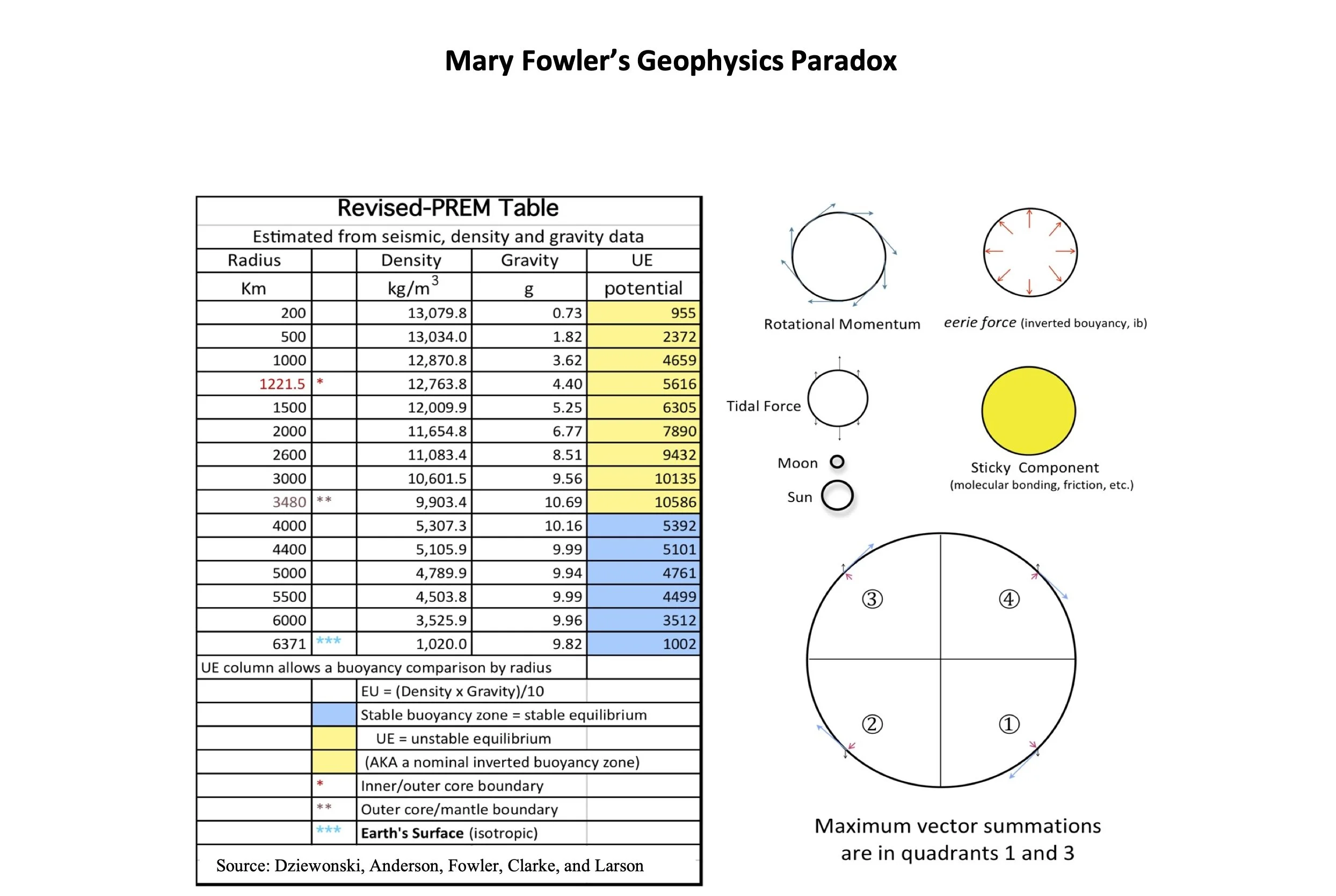
The one-to-one vector sums of quadrants 1&3 are greater than their counter-sums in quadrants 2&4. The ‘eerie force’ vector component of inverted buoyancy in the adjoining spheres is nonexistent in the stable equilibrium (blue) section of the above chart. These facts with varied sticky components create complicated, ratcheting spin dynamic possibilities.
This new paradigm extends into black-holes and challenges many likely antiquated assumptions, like the singularity assumption of Kerr and Blandford. These expanded options offer a plethora of inverted buoyancy scenario dynamics for both planets and black holes.
Ergo – a new chapter for theoretical physicists.
Are Entropy Anomalies Fractally Linked to this Geophysics Dark Energy curiosity?
A Historical Entropy Synopsis
Thermal variances moving toward temperature uniformity is instinctively understood. But a thermometer’s simplistic data are co-mingled with numerous caveats within thermodynamics. This somewhat psychotic overtone might be missing an essential component.
Importantly, over twenty Nobel Prize Laureates in physics have noted such curious anomalies.
A straightforward experiment where entropy in conjunction with IP theorys evaluated with Fowler’s PREM chart as an enlightening backdrop.
Specific Entropy Experiments
Synopsis of the Experiment
A most basic entropy assumption of eventual uniform temperature (UT) was evaluated. The unit minimum temperature (1 degree Celsius) established before the 1800s led to non-existent integer-size divergence from an entropy UT endpoint. However, the percentage of at least one-fifth unit fraction diversion from UT was dramatically increased as temperature decreases. Liquid nitrogen’s latent heat of evaporation observations dramatically increased the evidence of this anomaly. Are portions of entropy variation observations fractally linked to earth’s super-rotation as almostinsignificant forms of dark energy? The following experiments shed light on this question.
Experiments of 2022 and 2024: Materials, Methods, and Results
Materials: Two Omega Thermocouples (Type K probes); Distilled water; 80 proof ethanol, Liquid nitrogen (industrial grade); A 320 gm brass probe (Made from 8mmX90mm brass door hinge pins made into three circular layers with a center pin being the first layer, as the pins were sparingly secured by durable epoxy putty); Two small vessels of glass; A one-gallon vacuum dual-wall Yeti container, a small inverted ceramic plate; A seven nested faraday cage enclosure (with a least 2 layers of very snug faraday-gaussian-like with a 2.54 cm/layer of polystyrene) box. This 2 layered nesting exceeded 5 cm of polystyrene insulation often used as two containers for ‘HelloFresh’ deliveries.
Methods: First: A minimum of 4 hours between readings; establishing benchmarks were conducted, and described in more in the Detailed Appendix (which can be provided upon request); Next, the brass-probe in aqueous comparisons at 296 K and 276 K Ranges were conducted; next, a brass-probe/ethanol comparison at 249 K was conducted; Finally, the brass-probe immersed in liquid-nitrogen comparisons at 85.5 K were conducted. A large number of readings occurred in the 296 K – 249 K evaluations; these were conducted in side-by-side vessel configuration settings within the Yeti container.
Secondary Methods: The initial 2022 liquid nitrogen evaluation was brief. The time in liquid nitrogen surroundings was minimally 40 hours before uniform temperature (UT) evaluation was assumed to exist. (Plus, a total of 50+ hours of pre-cooling to roughly 253 K for all material prior to immersion in liquid nitrogen, and the Yeti was placed on the ceramic plate within ‘HelloFresh’ container.) The more traditional side-by-side comparison for the higher temperature readings were replaced with a ‘nested’ or ‘babushka doll style’ for the liquid nitrogen evaluation settings.
The 2024 liquid nitrogen evaluation had a 100% longer submersion (80 hours vs 40 hours) in liquid nitrogen and the brass probe’s epoxy had been ‘cured’ for 2 longer years.
Results and Observations:
All variations detected consisted of the brass probe emitting more energy than did the other vessel.
Simple entropy comparison results:
The over 900 comparisons at the 296K range had less than 0.0025% of delta 0.2K variations compared to the theoretical entropy end-point parameter of UT (uniform temperature). A reading divergence of over a delta 0.3K variation did not occur.
The over 150 comparisons at the 279K range had 3.2% with a delta 0.2K degrees or greater variation from ‘identical’ temperature readings and a reading divergence of over a delta 0.3K variation did not occur.
The 250K ethanol/aqueous fluid parameters had roughly 32% readings with a delta 0.2K degrees or greater variations from two separate runs for over 450 total evaluations. No visible enthalpy phase change was observed with ethanol at the 250K temperature range. However, the first run with over 100 evaluations had a 40% of delta 0.2K degree or greater variation, while the second longer 250K UT run had substantially less anomaly results, with roughly 30% having a delta 0.2K degrees; with no delta 0.3K degree or greater noted in these over 450 readings in a 75-day observational window.
These straightforward observations correlate very well to an increase diversion from the theoretical entropy UT endpoint as temperature settings are lowered. These observations can be argued as counter-intuitive to ‘a less total energy’; would imply a faster timeline toward achieving an equal temperature endpoint. These observations are also counter-intuitive to a basic assumption that entropy implies an eventual uniform temperature.
Condensed Matter setup; and anomalies noted:
Liquid Nitrogen observations of 2022: Initially, significant excessive boiling-off of the liquid mixture in the nesting vessel setup (like Babushka dolls nested) occurred. This nesting is better for determining the likely origin of energy. A timeline until boil-off was unnoticed for all items in the Yeti was established. This ‘cooling down’ timeline from roughly 245K to ‘no noticeable boil-off’ in the liquid nitrogen (LN) was observed from 4PM 9/23/2022 to 8AM 9/25/2022 (roughly 40 hours).
The pictorial below is a visual aid that clarifies the prose description of events and observations in this LN experiment.
Lines A represent the liquid nitrogen level range at 8:10AM, 9/26/2022; Lines B represents the time when a true thermal dynamic evaluation commences. Lines C are the liquid levels of each Babushka-vessel and the Yeti at 7:20PM on 9/26/2022.
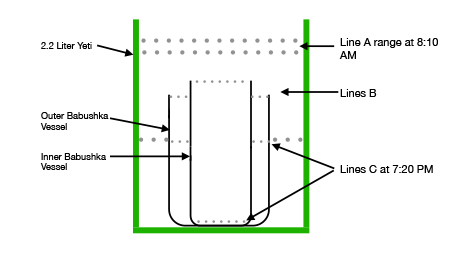
The temperature probe readings of this industrial grade liquid nitrogen (LN) were in the 85K-86K range with the probes used in this LN experiment. The brass device and 2 babushka vessels were placed in a freezer (roughly 245K) 2 days before they were submerged in LN. The brass device and 2 vessels in the afternoon of 9/23/2022 started their saturation in LN for a minimum of 46 hours. Upon quick visual at 7 PM on 9/25/2022, no LN boiling nor light fizzing from the brass device or vessels was observed during this partial LN re-filling (or ‘topping-off’) of the Yeti container. The ‘top off’ refilling of an over half LN-filled Yeti (with the brass device and the two nested glass open containers within the Yeti that had been continuously submerged since the evening of 9/23/2022). The Yeti was last re-supplied with LN on 9/26/2022 at 8:10AM. The Yeti was re-opened at 7:20 PM on 9/26/2022, and the contents were closely examined under misty observational conditions that ended before 7:35 PM. The inner glass vessel with the brass device had evaporated well over 89% of its liquid contents (originally presumed to be close to, but likely not, 100% liquid nitrogen removed), while less than 45% of the LN had evaporated in the larger babushka glass vessel and Yeti container.
The Liquid Nitrogen results of 2024: The 2024 liquid nitrogen experiment was essentially a repeat of the 2022 experiment, but with more than doubled the LN submersion time before uniform temperature (UT) was assumed to exist. Also, determining accurate LN levels was improved by reducing mist by maintaining a very high concentration of nitrogen surrounding the Yeti and its immediate workspace.
Liquid Nitrogen Summary: The ‘unknown sources’ of energy are unquestionably counter to entropy’s endpoint of ‘uniform temperature’ (UT) in all the liquid nitrogen trials. These energy/mass dependent observations enhance the conjecture that dark energy is nominally created all around us; and is mass-density dependent.
Discussion of the More Basic Observations: The 296K to 276K to 249K data runs had diversions of at least D 0.2K from UT of 0.0025% to 3.2% to roughly 33% respectively. This broad-based diversion from an anticipated ‘entropy endpoint’ (UT) as temperature is lowered unquestionably leads to numerous sub-plots. The latent evaporation of liquid nitrogen (LN) comparison was also semi-contradictory to the three temperature readings made in the 2022 experiment. But, this paper will remain focused on the contradictory trend of documented variations compared to a ‘classic entropy’ endpoint as the temperature decreases as demonstrated in our 296K to 276K to 249K data runs.
A more detailed Discussion of Condensed Matter Entropy/Enthalpy Observations: Over 50 hours of LN immersion occurred prior to the 2022 experiment. Possible explanations for this substantial UT-entropy/enthalpy anomaly are numerous. They include: cosmic ray variations from differing material, variation of slow chemical ‘energy releasing’ degradation which duplicating this experiment 2 years later dramatically reduced this particular conjecture. Other causes of anti-entropy UT endpoint results possibly include gravitational wave fluctuations, dark matter intrusion interactions. Finally and importantly, a tendency of dismissiveness of inverted physics dynamic conjecture is more difficult to defend. The now sound conjecture of the existence of earthly super-rotation; and the entropy liquid nitrogen experiments of 2022 of energy emission after attempting to achieve ‘uniform temperature’; and the 2024 replication with longer ‘uniform temperature’ timeline with a minimum of 1.8JgmofBrass/hr of energy release is remarkably consistent to the 2022 results. These experiments confirm that uniform temperature with substantially varying material is often unfeasible. These observations from straightforward experiments make the conjecture that: ‘Mass dependent Dark Energy surrounds us everywhere’ is very reasonable.
Summary
As fractals, these few entropy experiments complement our dark energy geophysics inner core super-rotation analysis. But they by no means create a compelling conjecture, until noteworthy citations in footnote 8 herein cite over 24 similar entropy endpoint curiosities; many found by numerous Physics Nobel Prize recipients. So, if CEM is still truly conserved while rotational energy exists contrary to Weinberg’s famous proof; then such a conservation parameter can be maintained by modestly amplifying space dimensions to maintain a constant energy density reality. This conjecture will update our ‘de facto conservation’ parameter. In other words, the redshifts, dark energy, an expanding universe, and spinors are logically explainable when utilizing inversion physics that guided this geophysics and entropy analysis.
Post Summary Questions
Assuming our conjecture is correct, there are specific questions. Some are: 1) Wouldn’t numerous super-rotating massive black holes lead to eventual ‘massive bangs’ be a more reasonable conjecture for the ‘microwave cosmic background’ than is ‘just one’ Big Bang?; 2) a) How does the rate of space expansion vary with varying intensity of dark energy? b) And how could these varying dark energy parameters be estimated? c) And how can varying conjectures be compared to observations?
Substantial acknowledgement and sincere thanks to: Mary Fowler, Seth Putterman, Diane Schwartz, James White, Daniel Sheehan, Lene Hau, Theodore Gamelin, Maya Wei-Hass, Fred Berends, Sharla Boehm, Judy Larson, Rena Zieve, Soren Samuelsson, Russell Howell, Johnathan Mitchell, Kim Griest, James Chappell, William Straub, Paul Steinhardt, James Allen, George Brady, John Trefny, Andrea Trombettoni, Derek Abbott, Keith Shillito, Leon Knopoff, David Jackson, Carolina Lithgow-Bertelloni, Peter Aleshire, Andrea Ghez, Norm Burkhard, Shawn Biehler, Glen Biasi, and Edward Teller.